

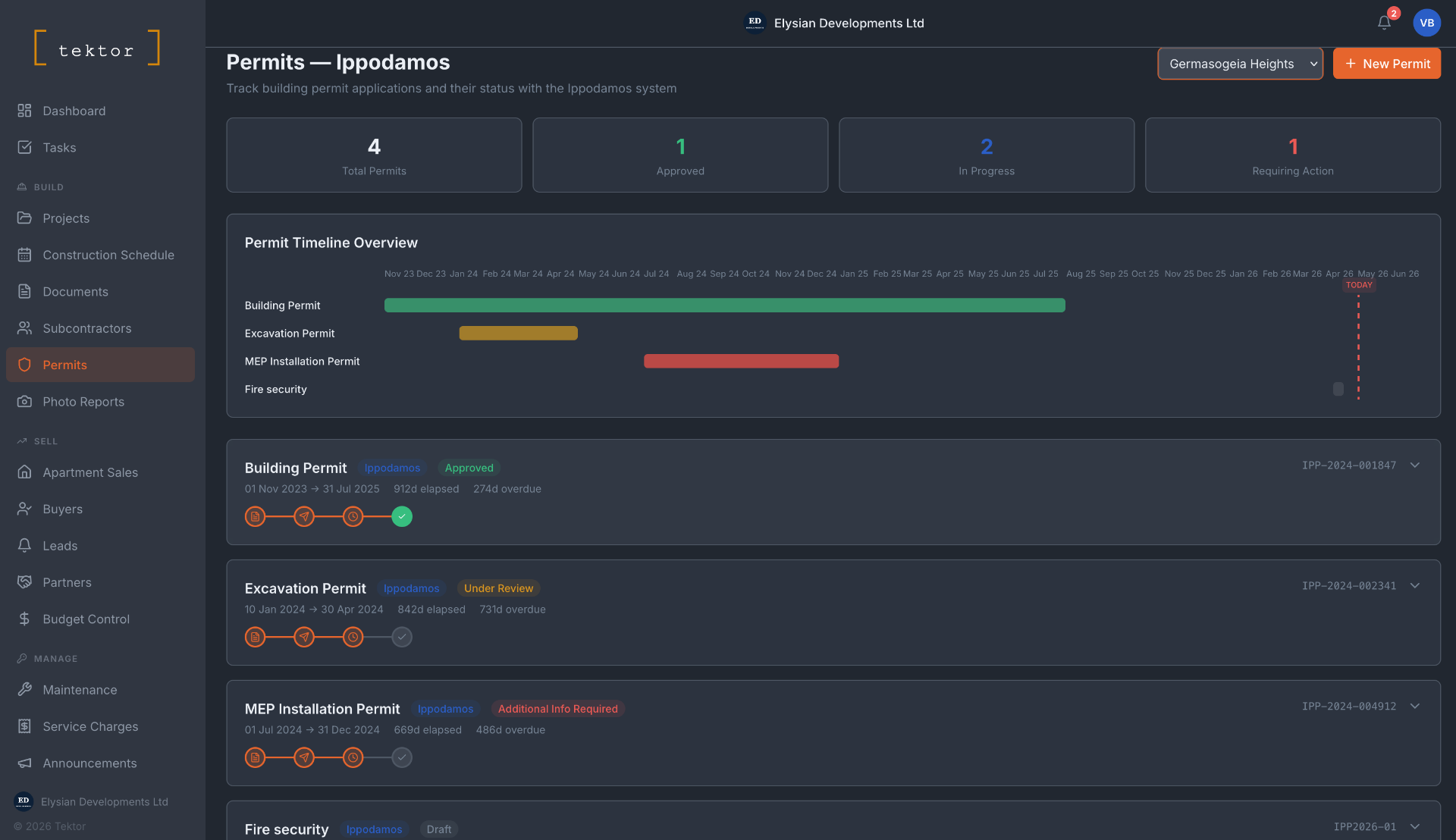
- The July 2024 EOA reform digitized permits — but real-time visibility for developers is still missing. Ippodamos is a portal, not a pipeline.
- System blackouts during peak submission hours are a widely reported complaint, and a mid-size developer often juggles many concurrent applications across the five EOAs.
- Every month a project sits in 'Pending' carries real financing, holding and contractor-idle costs — before you count lost presale momentum.
- Tektor's 3-step workflow (status logging → legal sync → investor reporting) replaces the black box with a board-ready command center.
On paper, July 2024 should have been the moment Cyprus development unshackled itself from analog bureaucracy. The reform consolidated permitting under five new EOAs (District Self-Government Organizations) and pushed the whole pipeline through a single digital portal: Ippodamos. Eighteen months later, in mid-2026, the verdict from the developer community is sharper than the press releases admit: we traded paper bureaucracy for digital bureaucracy, and the meter is still running.
The portal exists. Submissions go in. PDFs come out. But the layer between submission and approval — the part that actually drives your project P&L — is still a black box. Status updates arrive by email, sometimes. Conditions change without alerts. Reviewers rotate. And every developer we've spoken to in Limassol, Nicosia and Paphos has the same complaint: "We can submit faster than ever. We just can't see anything once it's in there."
The pattern is consistent across the developers we talk to: system blackouts cluster around peak submission windows (Monday mornings and month-end); project leads lose hours each week to manual portal-checking across the five EOAs; and a meaningful share of approved permits arrive with an altered condition that was never flagged proactively. Every extra week a Building Permit sits in 'Pending' adds financing and holding cost to the project.
From Municipalities to EOAs: The Digital Bureaucracy Trap
Before July 2024, planning and building permits were issued by individual municipalities. The process was slow, paper-heavy and political — but it had one underrated feature: relationships. You knew the planner. You walked to the office. You got an answer, even if the answer was "come back next month."
The EOA reform replaced 30+ municipal touchpoints with five regional super-authorities and a single online entry point. The intent was clean: standardize, digitize, accelerate. The reality is more nuanced. EOAs inherited backlogs, hired aggressively, and rebuilt internal workflows on top of Ippodamos in real time. Each EOA now interprets the same regulations slightly differently, and each maintains its own informal SLA — none of which appear on the portal.
This is the digital bureaucracy trap: the interface is modern, the data is locked. You get a confirmation number and a status field that updates twice. Everything between those two updates — the questions reviewers ask, the conditions they're considering, the documents they need — happens in private email threads your CEO never sees until something breaks.
The Bottleneck: Three Hidden Costs of an Opaque Permit System
The Status Silence
Permits sit in 'Pending' or 'In Review' for months without automated notifications, stalling multi-million euro project financing.
Data Fragmentation
Information is scattered between Town Planning, Building Permits, environmental reviews and EOA-specific add-on requirements.
Economic Impact
A 3-month delay in permitting can increase total project costs by 5–8% from interest, inflation and inactive contractor windows.
The Notification Gap: When a Silent Condition Change Becomes an Illegal Sale
This is the most dangerous failure mode of the current Ippodamos workflow, and it almost never makes the news. Permits in Cyprus are routinely approved with conditions — the EOA grants you the right to build, but only if you reduce the building coefficient by 5%, drop the top floor, or cut a unit's footprint by 1.5 m².
Here's the failure: that condition lands in the legal team's inbox as a PDF. The sales team is not on the email thread. The CRM still shows the original floor plate, the original unit count, the original sellable square meters. By the time someone notices the discrepancy — usually three weeks later, when a buyer requests an updated brochure — your sales team has already taken reservations on units that, technically, can no longer be built as advertised.
The legal exposure is real. A reservation agreement based on permit conditions that have been overruled is a refund request waiting to happen — and in Cyprus, where deposits often reach €50K–€150K per unit, the cumulative risk on a 30-unit project can wipe out an entire quarter of margin.
The fix isn't more lawyers. The fix is connecting permit status to the live sales inventory. When a revised condition comes in and you log it, the affected units flag as "Pending re-review" — blocking new reservations until the marketing team reissues compliant materials. That connection is exactly what the portal doesn't give you on its own, and exactly the gap a real estate developer CRM in Cyprus has to close.
The Hidden Cost of Delay
Permit delays aren't just an inconvenience — they carry real financial weight. When a permitting cycle you underwrote for nine months stretches to fifteen, the extra half-year piles up across several cost lines at once:
- Senior debt interest keeps accruing on drawn facilities for every extra month the project is stalled.
- Equity opportunity cost grows as capital stays locked in a project that isn't yet earning.
- Land carrying cost — taxes and insurance — runs the whole time, delivering nothing.
- Construction inflation resets material and labour pricing upward against your original budget.
- Lost presale momentum pushes launches into a softer window, eroding pricing power.
The net damage from a single opaque permitting cycle can reach a meaningful share of a project's gross development value — real money evaporated into financing and inflation rather than construction. This is the real cost of a portal that doesn't tell you anything until it tells you everything.
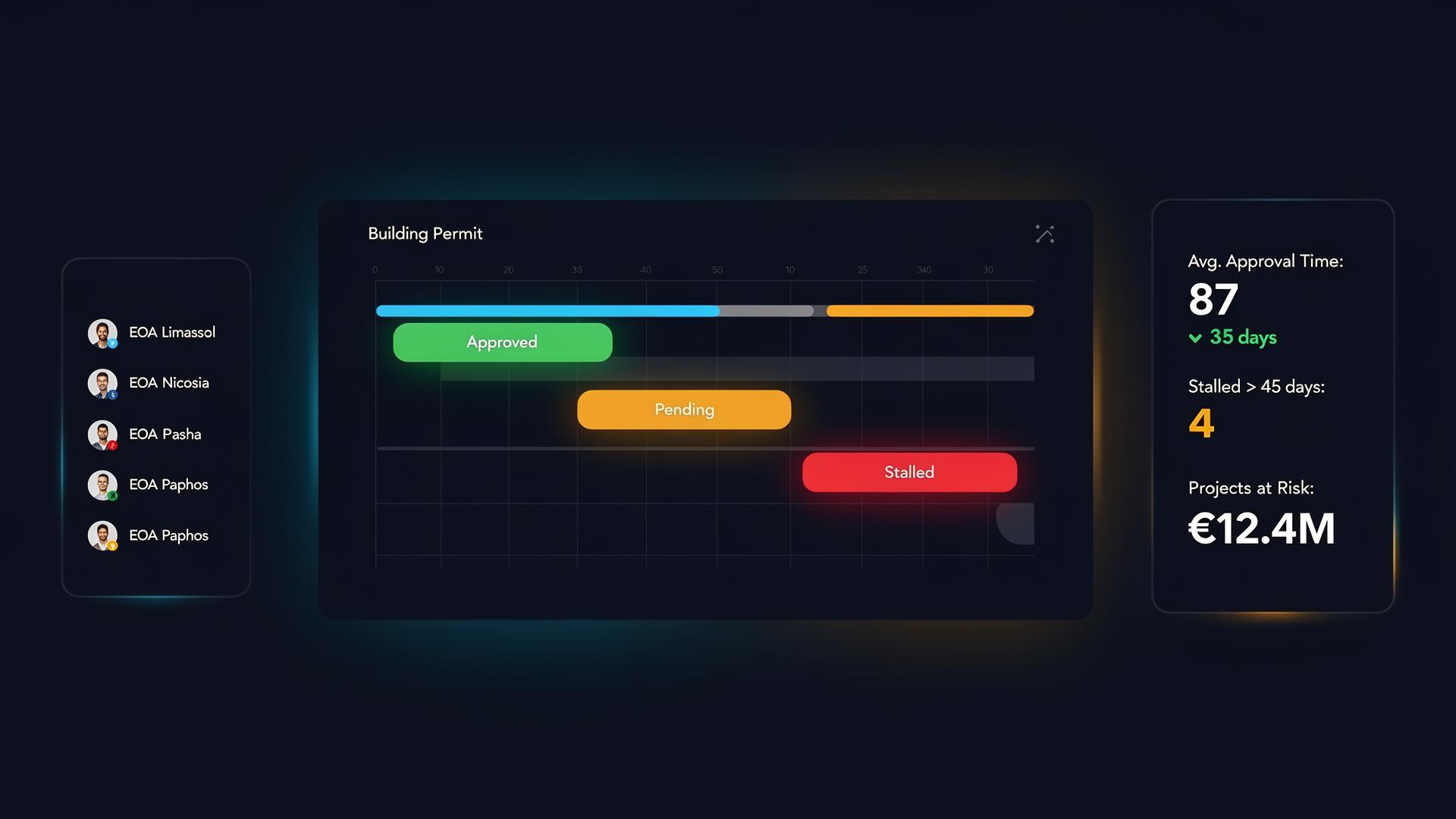
The Tektor Workflow: From Black Box to Command Center in 3 Steps
We don't replace Ippodamos — the EOAs require it as the system of record. We work on top of it. Tektor turns your Ippodamos exports into a structured, observable pipeline through a three-step workflow your finance, legal and construction teams can finally act on together.
Centralised status tracking
Tektor ingests Ippodamos exports and submission metadata on a scheduled cadence (or via secure manual upload), normalizes statuses across all five EOAs, and builds a digital twin of every application — files, conditions, comments, version history — linked to the right project unit.
Legal Team Sync
When you log a status change or a new condition, Tektor notifies the assigned legal owner and flags any units in the sales map affected by it. Status-aging reminders fire at 30, 15 and 5 days before auto-approval deadlines. No condition slips through email purgatory.
Investor Reporting
One click generates a board-ready 'Permitting Pipeline' report — €-at-risk per project, average approval time per EOA, projected launch dates, condition-change log. The same data feeds your LP updates, bank covenant reports and CEO dashboard automatically.
In the 2026 market, data speed is as important as construction speed. Developers who can visualize their permitting pipeline have a massive competitive advantage in securing financing and buyer trust.— Tektor Product Team


