


- Certification is the formal confirmation of how much contracted work a subcontractor has completed to date — the signed basis for each staged payment on a construction project.
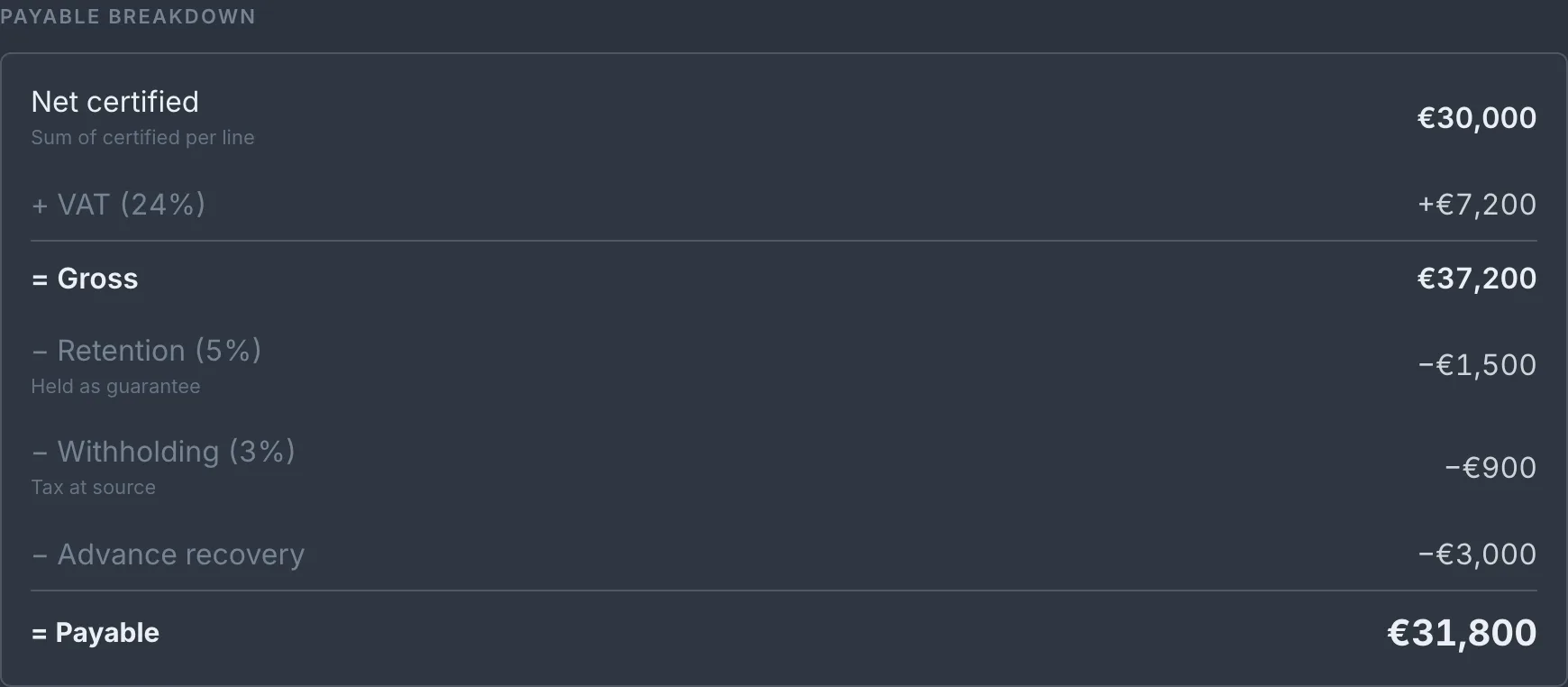
- A certified amount is not the amount paid. Retention (commonly 5–10%), withholding tax, VAT (19% Cyprus / 24% Greece) and advance recovery are all applied before the payable figure is reached.
- In Greece, technical works (τεχνικά έργα) carry a 3% withholding at source under the tax code — something generic international software simply doesn't model.
- Run by hand in a spreadsheet, the same errors recur: over-certifying, retention leakage, missed withholding, double-paid advances, and no audit trail.
- Tektor's Certifications module certifies work in stages, applies every deduction automatically, handles advances, enforces a two-step sign-off, and ties it all to the budget.
On a construction project, a subcontractor is almost never paid in one lump sum. They're paid in stages, as the work progresses — and each of those payments rests on a single question: how much work has actually been done, and what is the developer right to pay for it?
Answering that question properly is what "certification" means in construction. Get it right and payments are fair, cash flow is predictable, and the tax office is satisfied. Get it wrong — and the mistakes are expensive, hard to unwind, and often invisible until an audit or a dispute brings them to light.
This article explains what certification is, why it matters, and the specific errors it prevents — with the Cyprus and Greece context that generic international software tends to ignore.
What is certification in construction?
Certification is the process of formally confirming how much contracted work has been completed to date, so that a corresponding partial payment can be released to the subcontractor. It usually works like this:
- A subcontract is signed for a defined scope and value, broken into line items.
- Periodically (often monthly), someone assesses how much of each line item is now complete.
- That assessment is certified — reviewed and signed off — and becomes the basis for a payment.
- The next period repeats, tracking cumulative progress against the contract until the work is complete.
In other words, certification turns "roughly how far along are we?" into an exact, signed figure that money can safely be paid against. It's the backbone of progress billing on any project with subcontractors — and in enterprise tools like Procore it's a standard module. The problem is that most small and mid-sized developers don't run enterprise tools; they run spreadsheets.
Why it matters
Certification isn't paperwork for its own sake. It protects the developer on several fronts at once:
- Cash flow. You pay for work genuinely done, in step with progress — not ahead of it. Over-paying early is one of the fastest ways to lose leverage with a subcontractor who then underperforms.
- Fairness and disputes. A signed, line-by-line record of what was certified each period is the single best defence when a subcontractor disputes a payment — or when you dispute their claim.
- Tax compliance. Each certified payment carries deductions that have to be calculated and withheld correctly. Errors here aren't just internal — they're a problem with the tax authority.
- Control across a portfolio. A developer running several projects needs to see, at a glance, how much has been committed, certified and paid across every subcontract. Spreadsheets don't roll up; they drift.

The deductions: retention, withholding and VAT
This is where certification gets technical — and where Cyprus and Greece differ from the generic template. A certified amount is rarely the amount that gets paid. Several deductions apply:
- Retention. A percentage (commonly 5–10%) held back from each payment as a guarantee against defects. It's released later — typically part at practical completion, part at the end of the defects-liability period.
- Withholding tax. In Greece, technical works (τεχνικά έργα) carry a 3% withholding at source under the tax code — applied regardless of amount. Generic international software simply doesn't model this, which means teams end up patching it by hand.
- VAT. Standard rate 19% in Cyprus, 24% in Greece, applied on the certified value.
- Advance recovery. If an advance was paid at the start of the contract, a portion of it is recovered from each certification until it's repaid.
The payable figure is what's left after all of these are applied in the right order. One wrong percentage, one missed withholding, one advance recovered twice — and the payment is wrong, often by thousands.
The mistakes certification prevents
When this is run by hand, the same errors recur across the industry:
- Over-certifying. Paying for more than was actually built, because nobody tracked cumulative progress against the contract. Each month looks fine in isolation; the total quietly exceeds the contract.
- Retention leakage. Forgetting to hold retention, holding the wrong percentage, or losing track of what's been held and what's due for release.
- Missed or mis-calculated withholding. Especially the Greek 3% — easy to forget, painful to explain to the tax office after the fact.
- Double-paying advances. Recovering an advance inconsistently, or not at all, so the subcontractor is effectively paid twice.
- No audit trail. A payment goes out with no record of who assessed it, who approved it, or on what basis — which is exactly the record you need when a dispute or audit arrives.
- No sign-off discipline. One person both assessing and releasing payment, with no second check before money moves.
None of these are exotic. They're the everyday cost of running a money-critical process in a spreadsheet.
How Tektor handles certification
We built a certification module into Tektor precisely because this is where developers lose money quietly — and because the local specifics (Greek 3% withholding, Cyprus/Greece VAT, retention practice) are exactly what off-the-shelf tools get wrong. With Tektor you can:
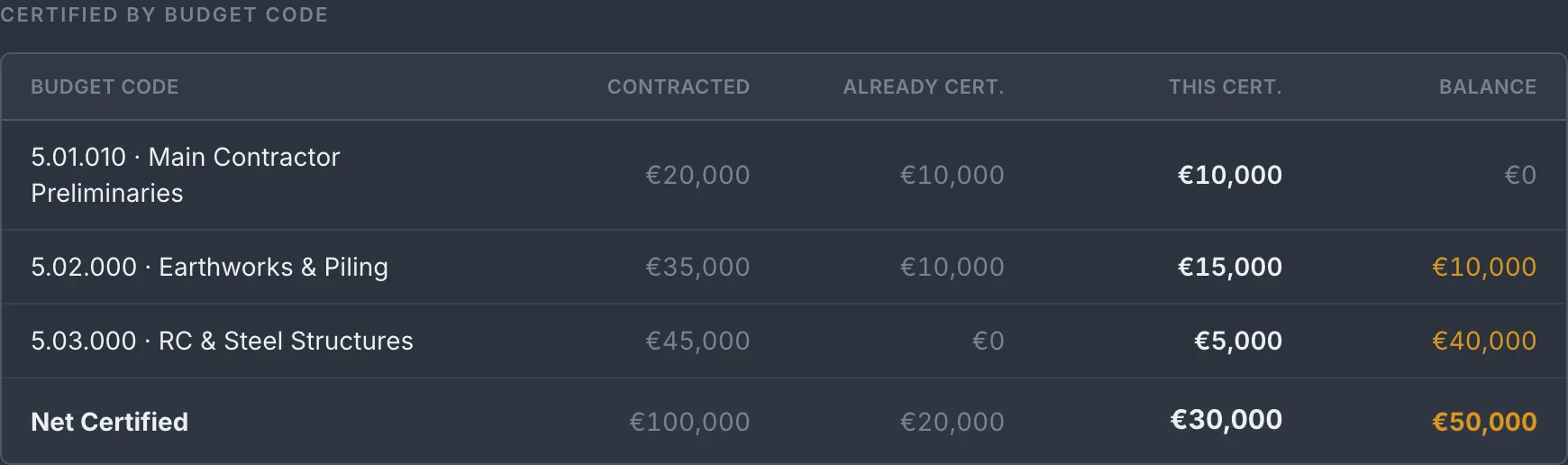
- Certify work in stages, line by line, with cumulative tracking — Contracted, already certified, this period, and balance — so the total can never silently exceed the contract.
- Apply every deduction automatically — retention, withholding (including the Greek 3%), VAT — with a clear breakdown showing exactly how the payable figure is reached: Net → VAT → Gross − Retention − Withholding − Advance = Payable.
- Handle advances and recover them — as a percentage or fixed amount, recovered proportionally or as a standalone payment, with the outstanding balance always visible.
- Sign off in two steps — a technical check, then an executive one — with finalised certifications locked and a full audit trail of who signed what, and when.
- See it against the budget — certified amounts roll into your budget view, so you can read the whole chain: Planned → Contracted → Certified → Invoiced → Paid.
It replaces the spreadsheet with a single, auditable workflow — built for how developers in Cyprus and Greece actually work. See the full Certifications module in Tektor →


